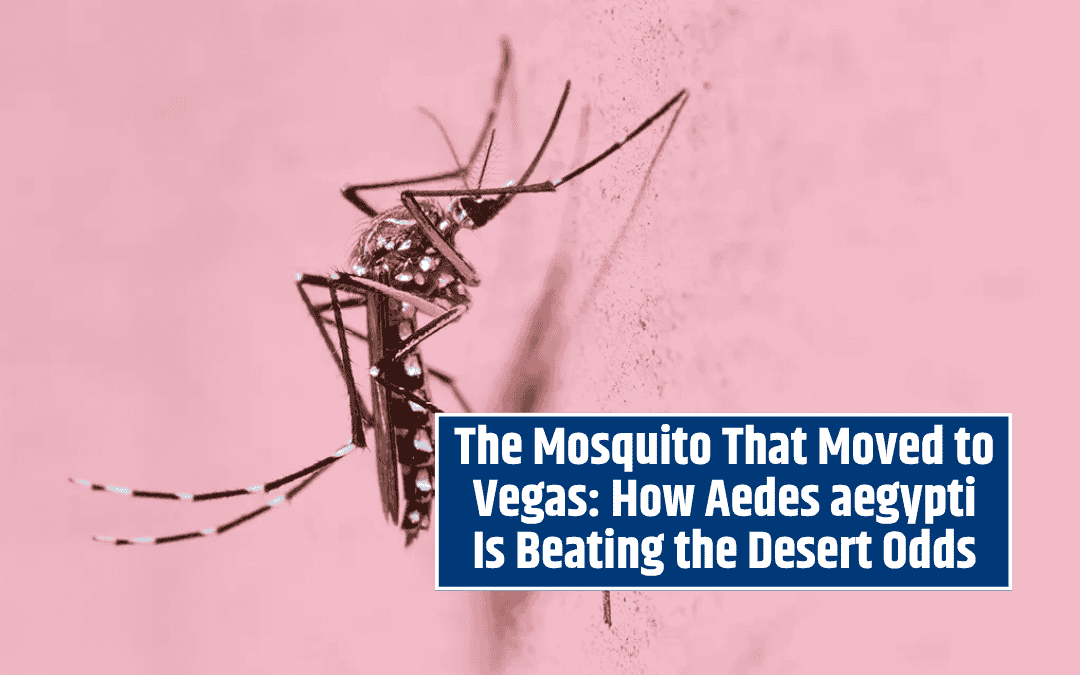
“What happens in Vegas stays in Vegas”—except, it seems, when mosquitoes move in. Scientists have confirmed that Aedes aegypti, the yellow fever mosquito known for spreading diseases like dengue, chikungunya, and Zika, has permanently established itself in the Las Vegas Valley. Once thought impossible, the insect is now thriving in one of America’s driest cities.
A Growing Threat
New research published in the Journal of Medical Entomology reveals that this mosquito is not only surviving—it’s expanding. Over a five-year period, scientists documented a 53 percent increase in Las Vegas census tracts showing mosquito activity.
“Our findings show Aedes aegypti is now established across much of the Las Vegas metro area,” says Dr. Saul Lozano of the CDC.
Not Yet a Disease Outbreak
While the mosquito can transmit serious viruses, its presence doesn’t guarantee illness. Disease risk arises only when an infected traveler introduces a virus into a region where Aedes aegypti is active, giving the mosquito time to become a carrier before it dies—usually within a month.
Still, experts warn that even this slim window can be enough to spark outbreaks under the right conditions.
Desert Doesn’t Mean Mosquito-Free
Las Vegas’s arid climate might seem like a natural defense, but this species doesn’t need much water. Female Aedes aegypti mosquitoes can lay eggs in tiny puddles—anything from a birdbath to a discarded jar.
Their eggs survive months without moisture and hatch within days once submerged, making urban yards and patios ideal breeding grounds.
Resilient and Resourceful
Despite the desert’s reputation for extreme heat, Aedes aegypti is remarkably adaptable. While the optimal hatching temperature is 77°F, some eggs can hatch even at 14°F. “Changes in local conditions can allow for pockets of suitable habitats to emerge in new places,” says Lozano.
Climate change and warmer winters may be giving the species an unexpected advantage in the Mojave Desert.
Tracking a Silent Invasion
Researchers tracked mosquito populations across Las Vegas by dividing the city into U.S. Census tracts—each representing a few thousand residents. In 2017, only five of 117 tracts showed activity. By 2023, 147 of 276 tracts did.
“This highlights how quickly Aedes aegypti can expand once established,” Lozano says. Traps were often placed after residents reported nuisance mosquitoes.
How the Mosquito Got There
Experts believe Aedes aegypti spread into Nevada from California, where it was first detected in 2013. The species likely traveled north from Mexico years earlier, hitchhiking through human movement and trade.
Today, it’s entrenched in many southwestern cities, including Phoenix, Tucson, and now Las Vegas—defying earlier models that predicted the desert heat would keep it at bay.
When the Rains Come
Researchers noted a surge in mosquito numbers in 2022 and 2023, especially from late August through October. The spike coincided with heavy rainfall, including remnants of Hurricane Hilary, which created temporary pools perfect for breeding.
The same period saw an uptick in public mosquito complaints, likely fueled by media attention and growing awareness of the insect’s presence.
A Call for Vigilance
The findings have major implications for public health. “This highlights the need for effective vector control measures and public health strategies,” Lozano and colleagues write.
The combination of adaptable mosquitoes, warming temperatures, and expanding urban water sources poses an ongoing challenge. Without proactive control, Las Vegas could become a hub for vector-borne diseases.
Betting on Prevention
For now, officials stress prevention over panic. Covering containers, clearing standing water, and using repellents remain the best defenses. The desert may seem an unlikely mosquito haven, but nature has once again proven its unpredictability.
The question is no longer whether Aedes aegypti can survive in Las Vegas—it’s how the city will learn to live with it.
FAQs
Can mosquitoes really survive in Las Vegas?
Yes. Despite the city’s desert climate, Aedes aegypti mosquitoes have adapted to survive by breeding in small water sources like flowerpots, gutters, and birdbaths. Their eggs can remain dormant for months and hatch when exposed to water, allowing the species to thrive even in dry environments.
What diseases can Aedes aegypti spread?
Aedes aegypti is capable of transmitting several viruses, including dengue, Zika, yellow fever, and chikungunya. While no local outbreaks have occurred in Las Vegas, the presence of this mosquito increases the risk if an infected traveler introduces one of these viruses.
How did Aedes aegypti get to Las Vegas?
Researchers believe the mosquito spread northward from Mexico into California around 2013 and later into Nevada. It likely hitched rides through human travel, shipping, or trade routes. Once introduced, the species established itself quickly in Las Vegas neighborhoods.
Does climate change play a role in mosquito expansion?
Yes. Warmer temperatures and milder winters allow mosquito eggs to survive longer and expand into new regions. Climate change can also extend breeding seasons, increasing the number of generations produced each year.
How can residents protect themselves from mosquito bites?
Remove standing water around homes, cover outdoor containers, and repair window screens. Use EPA-approved insect repellents and wear long sleeves during dawn and dusk when mosquitoes are most active. These simple precautions can significantly reduce the risk of mosquito-borne diseases.