Just as beekeepers continue to battle the colony-devastating Varroa destructor mite, scientists warn of another unwelcome pest on the move.
The Asian bee-killing mite Tropilaelaps mercedesae could soon reach North America, posing a severe new threat to honey-bee populations and, by extension, to the global pollination systems that sustain agriculture.
A Stowaway With Global Reach
Like Varroa, Tropilaelaps mercedesae spreads by hitchhiking on adult bees. A study published in January in the Journal of Economic Entomology shows the mite can travel on the western honey bee (Apis mellifera), the world’s most common managed pollinator.
Because these bees live on every continent except Antarctica, the discovery has raised international alarm among scientists and beekeepers.
First Evidence of a Dangerous Partnership
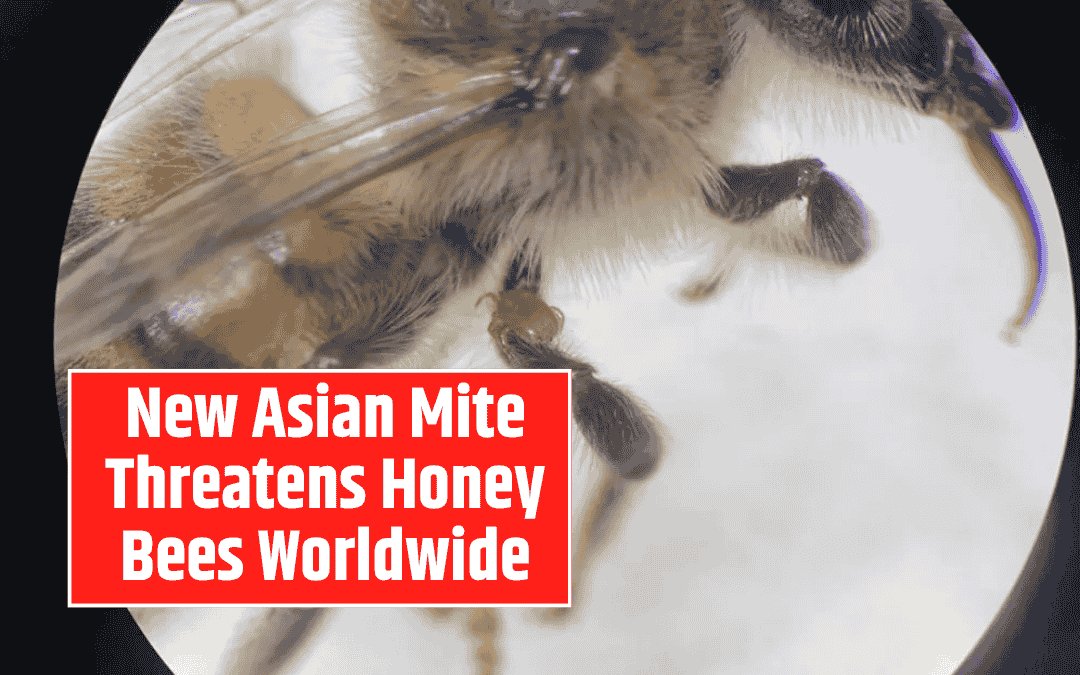
Researchers at Chiang Mai University in Thailand trapped western honey bees leaving experimental colonies and discovered the mites clinging to them.
It was the first confirmed evidence that Tropilaelaps mites—normally parasites of immature bees—can ride adult bees, potentially dispersing quickly to neighboring colonies. This airborne transport dramatically increases their spread beyond the slower transfer through beekeeper materials.
From Asia to Europe—And Beyond
In only fifty years, T. mercedesae has swept across Asia and recently appeared in Georgia and parts of southern Russia. Its growing proximity to Europe heightens concern that it could reach western nations through trade or migratory bees.
The U.S. Department of Agriculture’s Animal and Plant Health Inspection Service (APHIS) now actively monitors for the mite as a possible invasive species.
Field Research From Thailand
The Auburn University–Chiang Mai research team collected bees from six colonies between July 2023 and February 2024. Using funnel traps, they confirmed mites attached to bees leaving the hive to forage.
This finding proves that adult bees can act as phoretic hosts—carriers that transport organisms unable to move long distances on their own.
Understanding Phoresy in Bees
The act of one species attaching to another solely for travel is known as phoresy. Ticks are a well-known example. T. mercedesae originally used the giant honey bee (Apis dorsata) for transport, but its adaptation to the western honey bee gives it far greater reach and destructive potential, threatening commercial beekeeping across multiple continents.
When Infestation Levels Rise
The study found mites hitch rides on adults only when brood infestations are high. Colonies with less than 2.5 percent of infected brood cells showed no mites on foragers.
Heavy infestations appear to push mites to seek new hosts as their primary food source—the developing brood—becomes depleted, prompting migration to adult bees for survival.
A Deadly Efficiency
Lead author Rogan Tokach, Ph.D. candidate at Auburn University, explains that Tropilaelaps mites can cause even greater colony losses than Varroa. They breed rapidly inside brood cells, feeding on larvae and weakening developing bees.
“The mite cannot feed on adult honey bees,” Tokach notes, “but it will climb onto them as a potential source of dispersal to other colonies.”
Short-Lived Males, Long-Lived Females
Inside brood cells, mites mate just before capping, with females laying eggs during the pupal stage. Researchers found only females on trapped bees, suggesting that successful spread depends on a single gravid female reaching a new colony.
Males live only about five days, compared with fifty for females, making joint dispersal events rare but potentially devastating.
Potential for Rapid Global Spread
If a mated female mite rides an adult bee into an uninfested hive, she can immediately begin laying eggs, launching a new infestation.
With western honey bees’ massive global distribution, this ability could accelerate the mite’s expansion at an unprecedented rate, especially in regions already struggling to manage Varroa outbreaks.
A Growing Concern for Beekeepers
The discovery underscores how fragile honey-bee health remains under mounting parasitic pressures. Monitoring, early detection, and international cooperation will be crucial to preventing Tropilaelaps mercedesae from repeating the catastrophic global spread of Varroa destructor.
As researchers continue their surveillance, beekeepers worldwide remain on high alert for the next mite invasion.
FAQs
What is Tropilaelaps mercedesae?
Tropilaelaps mercedesae is a parasitic mite originally from Asia that infests honey bee colonies. It feeds on developing bee brood, causing deformities and weakening hives. Recent studies show the mite can hitchhike on adult western honey bees, which may accelerate its global spread.
Why are beekeepers concerned about Tropilaelaps mites?
Beekeepers fear Tropilaelaps mites because they can spread faster and potentially cause more damage than the already destructive Varroa mites. Their ability to attach to adult honey bees means they could travel quickly between colonies and regions, threatening global pollination systems and honey production.
Where has Tropilaelaps mercedesae been found?
The mite has spread rapidly across Asia over the past 50 years and was recently detected in Georgia and parts of southern Russia. Scientists are warning that it could reach Europe and North America, where the western honey bee is widespread.
How do Tropilaelaps mites spread between colonies?
These mites attach themselves to adult honey bees through a process called phoresy. When infestation levels inside a hive become high, mites latch onto foraging adults and can be carried to other colonies. Even though they cannot feed on adult bees, they use them as vehicles for dispersal.
How can the spread of Tropilaelaps mites be prevented?
Preventing the spread of Tropilaelaps mites requires vigilant monitoring, early detection, and strict biosecurity measures. Beekeepers should inspect brood regularly, follow quarantine guidelines, and cooperate with agricultural authorities to report suspected infestations.