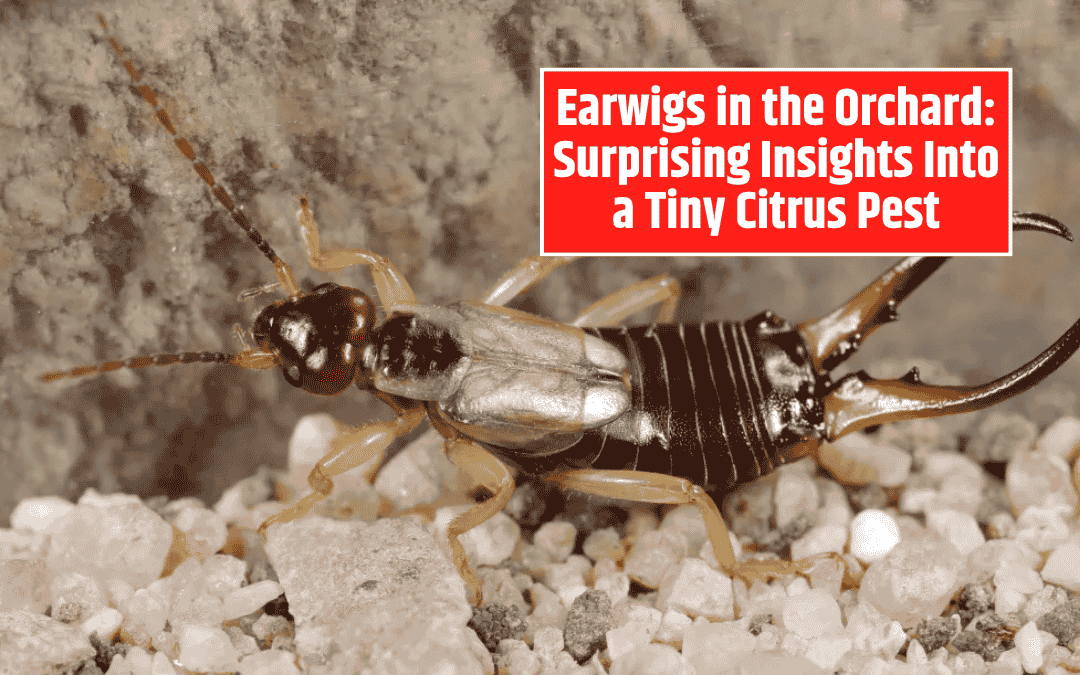
The European earwig (Forficula auricularia) has lived in the United States for over a century, thriving across most regions except the far Southeast.
Known for its pincers and nocturnal habits, this omnivorous insect has earned a mixed reputation—sometimes as a pest feeding on crops, and sometimes as a beneficial predator that consumes aphids and other garden pests.
A New Suspect in Citrus Damage
Recent studies suggest that earwigs may be damaging citrus groves in both Europe and the U.S. In California, researchers observed that earwigs feed on young, developing citrus fruits, causing scarring.
However, the extent of this damage remains unclear. To investigate, scientists at the University of California, Davis, examined earwig activity in Central Valley citrus orchards to determine when and how these insects interact with fruit trees.
Tracking Earwig Behavior in Citrus Groves
Led by entomologist Jay Rosenheim, Ph.D., now retired from UC Davis, the research team found that earwigs begin feeding on budding fruits earlier in the growing season than expected. Interestingly, their numbers didn’t directly correlate with the amount of fruit damage. The study also revealed that earwigs climb up and down tree trunks during early fruiting—well before flower petals start to drop.
Inventing a Farmer-Friendly Sampling Tool
Before analyzing behavior, the researchers had to solve a practical problem: how to collect earwig samples efficiently. After testing four methods, they developed a simple yet effective trap—small wooden boards costing under $2 each.
When placed flat on the ground at the edge of a tree canopy, these boards consistently attracted more earwigs than other sampling techniques.
A Cost-Effective Monitoring Method
The team tested 27 wooden board traps and found them to be ideal for sampling nocturnal earwigs. They combined these traps with sticky barriers placed around some tree trunks to prevent climbing, leaving others unbarriered as controls.
Over two years, they used this setup in 93 commercial citrus blocks, giving growers a practical tool for monitoring earwig activity.
Sticky Barriers Show Promise
Sticky barriers proved effective at stopping earwigs from reaching the trees—especially when applied early in the season. Previous research had shown such barriers could reduce fruit damage by up to 50 percent.
However, even with these defenses, the UC Davis team found that earwig population density didn’t necessarily predict the level of fruit scarring observed in orchards.
Untangling the Economic Impact
Quantifying the true economic damage caused by earwigs remains challenging. “The economic impact is hard to pin down,” Rosenheim explains.
“When we see fruit damage, we can’t always tell if it’s from earwigs or from other early-season pests, such as fork-tailed bush katydids, which also chew on small fruits.” This uncertainty complicates efforts to label earwigs as strictly harmful or benign.
An Unsolved Mystery of Movement
One of the study’s most puzzling findings was the earwigs’ constant travel up and down the trees. The reasons behind this movement remain unclear. “We still don’t fully understand what all that movement was about,” Rosenheim admits.
It’s possible the insects move to regulate temperature, find shelter, or search for food, but more research is needed to confirm these hypotheses.
Balancing Pest and Beneficial Roles
The research highlights the earwig’s complex role in agricultural ecosystems. While capable of scarring young fruit, the insects also prey on soft-bodied pests that damage crops.
Their dual nature as both pest and protector makes management strategies tricky—overcontrol could inadvertently eliminate a natural ally against more destructive insects.
Looking Toward Future Research
Rosenheim, who retired from UC Davis in June 2024, sees this study as a foundation for future discoveries. “New workers will follow me, and I hope that my work will be a stepping stone toward bigger things to come,” he says.
As scientists continue to explore the European earwig’s behavior, growers gain valuable insights into managing an insect that is far more complex than its size suggests.
FAQs
Do European earwigs damage citrus fruit?
Yes. Researchers at the University of California, Davis, found that European earwigs (Forficula auricularia) feed on young, developing citrus fruits in California’s Central Valley. Their feeding can cause fruit scarring, although the overall economic impact and extent of damage are still being studied.
Are earwigs harmful or beneficial to crops?
European earwigs are considered both pests and beneficial insects. While they can damage tender crops and young fruits like citrus, they also feed on aphids and other soft-bodied pests, providing natural pest control. Their role depends on the crop and environmental conditions.
How do scientists study earwig activity in orchards?
UC Davis researchers developed a simple and affordable sampling method using small wooden board traps placed under citrus trees. These traps, which cost less than $2 each, proved highly effective at capturing earwigs and tracking their movement throughout the growing season.
Do sticky barriers help prevent earwig damage?
Yes, but timing matters. Sticky barriers applied early in the citrus growing season can stop earwigs from climbing trees and feeding on developing fruits. Studies have shown these barriers can reduce fruit damage by about 50 percent when used correctly.
Why do earwigs climb citrus trees?
Researchers observed earwigs traveling up and down citrus trunks during early fruiting, but the reason for this behavior is not yet fully understood. It may be related to feeding, temperature regulation, or seeking shelter. More research is needed to clarify their movement patterns.