When people imagine undiscovered species, they picture remote jungles or unexplored islands. Yet the world’s next great wilderness may be closer than we think—right in our cities. Scientists are increasingly finding new life forms in urban environments, where moss, trees, and park trails conceal creatures unknown to science.
A Surprising Discovery in China’s Megacity
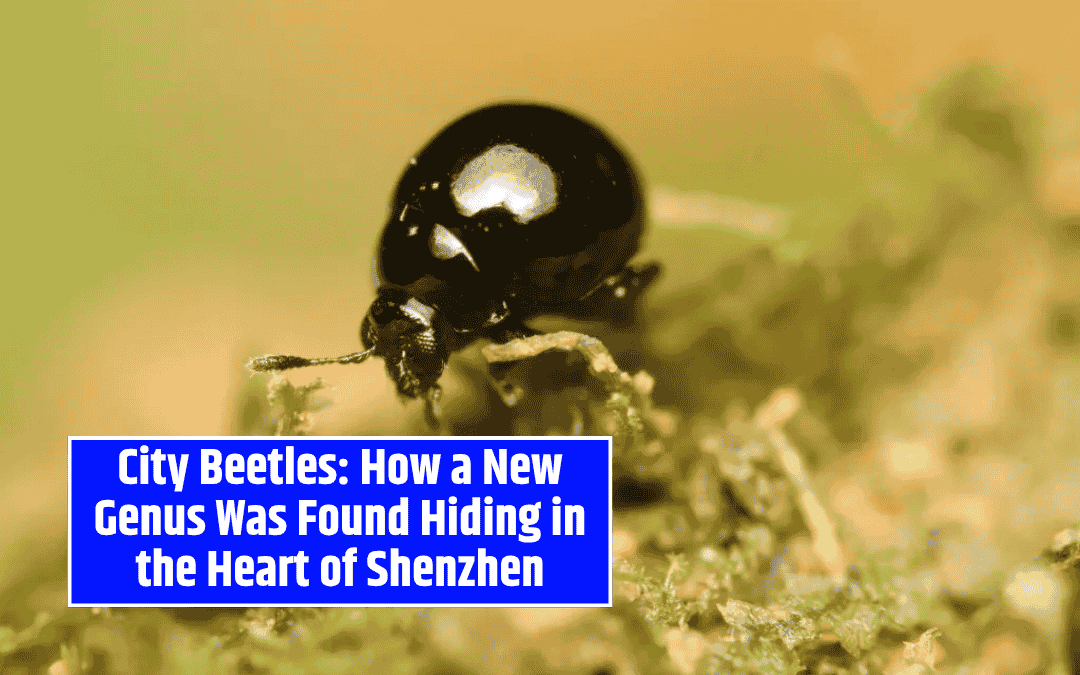
In June, researchers revealed a remarkable find in Insect Systematics and Diversity: an entirely new genus of flightless, moss-dwelling flea beetles discovered in Shenzhen, China.
The team—led by Yongying Ruan, Ph.D., and Albert Damaška, Ph.D.—stumbled upon the beetles not in a tropical forest, but along the edges of park pathways in one of the world’s largest megacities.
Nature Thriving Among Skyscrapers
Home to nearly 20 million residents, Shenzhen is a sprawling metropolis on China’s southern coast. Despite its rapid development, the city maintains an extraordinary green network, with over 1,000 parks and nearly 40% forest coverage.
These pockets of greenery, often designed for recreation, have quietly become refuges for species like the newly identified Punctaltica.
How Scientists Found the Beetles
The research team first spotted the beetles nestled in thin layers of moss along shaded trails. To learn more, they scoured city parks and nearby forests at night using high-color rendering headlamps.
Using aspirators—small suction tools—they collected specimens, later rearing them in laboratories to observe their full life cycle and confirm their classification.
A Genus Like No Other
Through DNA barcoding and morphological analysis, the team confirmed that these beetles represented a brand-new genus, which they named Punctaltica.
Two species emerged from their research—P. shenzhenensis and P. montana. The former appears to live only in three Shenzhen parks, making it an extraordinarily localized and fragile discovery.
Adapted to a Life of Moisture
The Punctaltica beetles are extreme specialists, relying on the damp environment of moss cushions. Their numbers surge during Shenzhen’s humid spring months and plummet when the air dries. Laboratory tests showed that eggs and larvae desiccated rapidly under low humidity—an hour or less for eggs and only half that for larvae.
Evolution’s Ingenious Design
To survive these challenges, the beetles evolved remarkable adaptations. They produce fewer eggs than other flea beetles, but each one is enormous—about 61% the length of an adult. Larger eggs yield larvae with smaller surface-area-to-volume ratios, helping them retain moisture.
To further safeguard their offspring, females coat each egg with feces, forming a natural shield against drying and predators.
Faster Growth, Lower Risk
Another curious trait sets Punctaltica apart: its larvae undergo only two stages instead of the typical three. By shortening development, the species reduces the time spent in vulnerable molting phases, when moisture loss can be fatal.
Every stage of its life is tuned to one goal—holding onto precious humidity in an urban landscape that fluctuates between wet and dry extremes.
The Conservation Paradox
Discovering new species in cities poses an unexpected dilemma. Routine park maintenance—such as leaf clearing or herbicide use—could easily destroy habitats where these beetles live. In fact, researchers note that a recently discovered fly species in New York City’s Central Park may have gone extinct after similar human interventions.
Rethinking Urban Nature
The Punctaltica discovery challenges the notion that nature and cities are separate realms. “We need large protected areas like national parks,” say Ruan and Damaška, “but that doesn’t mean we can neglect the places we already inhabit.”
Urban parks, gardens, and green roofs might be home to countless unseen organisms—small reminders that life persists even in concrete jungles.
FAQs
Where was the new beetle genus discovered?
The new flea beetle genus, Punctaltica, was discovered in Shenzhen, China—one of the world’s largest megacities. Researchers found it living in moss along park trails and forest pathways within the city’s extensive urban park system.
Why is this discovery important?
Finding a completely new genus in a heavily urbanized area challenges traditional ideas about biodiversity. It shows that cities can harbor unique species, emphasizing the need to include urban spaces in conservation efforts.
What makes the Punctaltica beetles unique?
These beetles are flightless, moss-dwelling, and highly moisture-dependent. They produce unusually large eggs and have only two larval stages—adaptations that help them survive in the unstable humidity of city environments.
How can urban species like these be protected?
Simple changes in park management—such as avoiding excessive pesticide use, maintaining moss patches, and reducing leaf litter removal—can help protect species that rely on microhabitats within city parks.