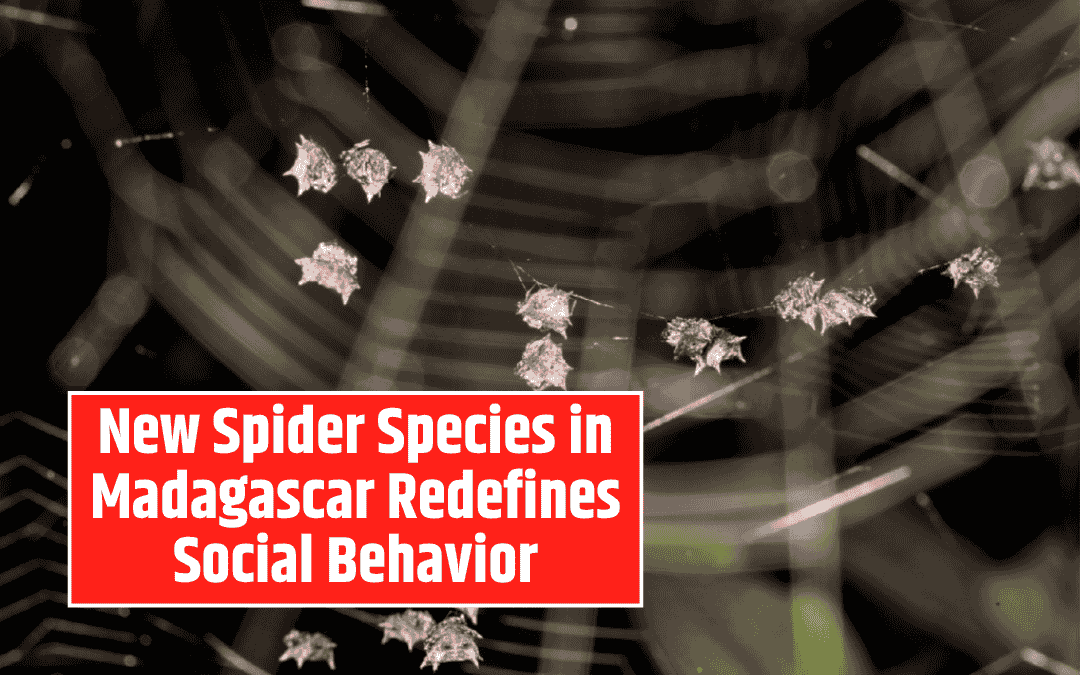
Scientists in Madagascar have uncovered a new species of spider that challenges everything we know about arachnid behavior. The species, Isoxya manangona, was described in Insect Systematics and Diversity after researchers found colonies of these spiders living and interacting in ways never seen before among spiders.
An Accidental Encounter
The discovery happened purely by chance. Ingi Agnarsson, Ph.D., a zoology professor at the University of Iceland, and his team were on an expedition searching for bark spiders when they noticed something unusual.
From their vehicle, they spotted several webs grouped closely together—an odd sight for creatures known to be fiercely solitary.
Colonies of Cooperation
When the researchers stopped to investigate, they were astonished. They found clusters of interconnected webs built by adult female spiders, while dozens of males perched peacefully on a single, central line.
These colonies, some containing up to 41 female webs and 38 males, displayed a level of social structure rarely observed in spiders.
Naming a Unique Species
The researchers named the new species Isoxya manangona, drawing from the Malagasy verb “manangona,” meaning “to gather” or “aggregate.”
The name perfectly fits the spider’s remarkable behavior—forming organized groups where males and females coexist in harmony rather than in the typical aggressive, solitary fashion of most spiders.
Breaking the Mold of Solitary Spiders
Spiders are notorious for their isolation and even cannibalism. Out of the 50,000 known spider species, only about 0.1 percent show any social or colonial tendencies.
In most cases, those that do form colonies are composed of close relatives, often juveniles or females working together. The peaceful coexistence of unrelated adult males, however, is entirely new to science.
Hints of a Lekking System
The team believes this behavior might represent a “lekking” mating system. In such systems—common in birds and some insects—males gather in groups, or “leks,” to attract females through displays or signals.
While lekking has been documented in many animals, it has never before been observed in spiders, making Isoxya manangona a fascinating exception.
Peaceful Males, Unusual Dynamics
Even more surprising was the lack of aggression among the males. Normally, male spiders are highly territorial and prone to fighting, especially when competing for mates. Yet these males shared their central line peacefully.
Genetic analysis revealed that while male spiders had slightly less genetic diversity than females, most individuals in the colonies were not related, deepening the mystery.
Unanswered Questions About Communication
Although the scientists did not witness active mating displays, Agnarsson suspects that the spiders may communicate through vibrations or pheromones rather than visual cues, since most spiders have poor eyesight.
Female choice was not directly observed, leaving the mating mechanisms and the purpose of male aggregation open to speculation.
Conservation Implications
The discovery site—within a disturbed area of a Madagascar nature reserve—raises important conservation questions. Researchers need to better understand the distribution, population size, and ecological needs of Isoxya manangona to protect this newly identified species.
Its unique behavior makes it not only a biological curiosity but also a potential indicator of ecosystem health.
A Glimpse Into Spider Evolution
This discovery challenges the long-held belief that spiders are strictly solitary. It opens new avenues for studying how complex social systems evolve even in species known for aggression and competition.
Understanding what allows these males to tolerate one another could reveal deep insights into behavioral evolution across the animal kingdom.
A Mystery Waiting to Be Solved
Agnarsson emphasizes that much remains unknown. “We’re hypothesizing that these spiders show lekking behavior based on the available evidence,” he says.
“We didn’t observe actual mating in the field.” Still, the evidence points toward an unprecedented form of cooperation among male spiders—something scientists are eager to explore further.
Redefining the Rules of Nature
The discovery of Isoxya manangona reminds us how much remains to be learned about life on Earth.
In a world where spiders are expected to fight and fend for themselves, these tiny creatures from Madagascar have rewritten the rules—showing that even nature’s loners can sometimes come together in surprising, harmonious ways.
FAQs
What is Isoxya manangona?
Isoxya manangona is a newly discovered species of kite spider found in Madagascar. Unlike most spiders, it forms colonies where males and females coexist peacefully, showing unique social behaviors not previously recorded in spiders.
Where was Isoxya manangona discovered?
Researchers discovered Isoxya manangona in a disturbed area of a Madagascar nature reserve. The team, led by Dr. Ingi Agnarsson from the University of Iceland, stumbled upon the colonies while searching for another spider species.
Why is this spider’s behavior unusual?
Most spiders are solitary and aggressive, but Isoxya manangona males live side by side without conflict. This peaceful coexistence may represent a lekking mating system, where males gather to attract females—a behavior never before seen in spiders.
What does the name Isoxya manangona mean?
The name ‘manangona’ comes from the Malagasy verb meaning ‘to gather’ or ‘to aggregate.’ It reflects the spider’s distinctive behavior of forming colonies with interconnected female webs and grouped males.
What are the conservation implications of this discovery?
Since Isoxya manangona was found in a disturbed habitat, scientists emphasize the need for conservation research. Understanding its population size, distribution, and ecological needs is essential to ensure the species’ protection.